

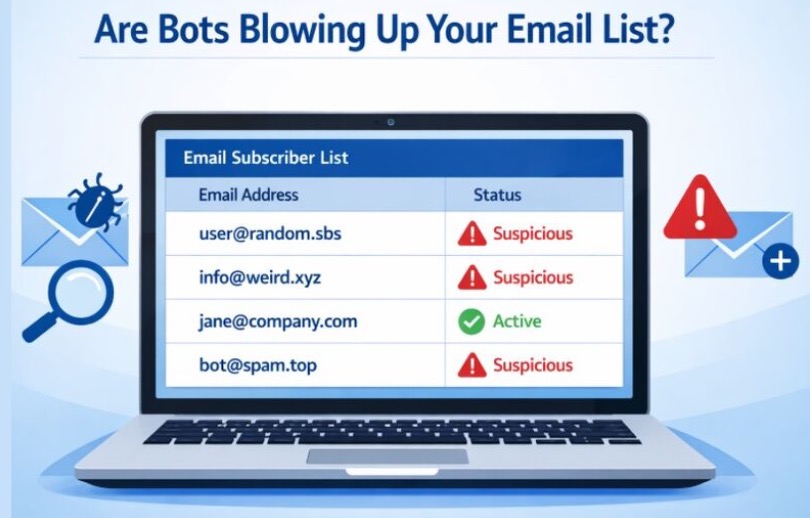
If you run a newsletter or blog, it might be worth taking a closer look at your subscriber list.
I felt compelled after my own error to give a heads up to clients and other marketers – and for those of you already on top of this, you must have better bot protection than I did. When I reviewed my CRM and email lists recently, I was pretty shocked by the volume of sign‑ups that clearly weren’t people who actually wanted to read my content.
Many appeared to be automated submissions. Over the past few months, I noticed a large increase in sign‑ups with domain endings such as:
.sbs
.xyz
.top
.click
.site
.online
.help
.store
.club
.space
.website
.info
Some are easier to spot as crawlers than others. And to be clear, not every domain that doesn’t end in .com or .org is spam. The internet has introduced a lot of new domain extensions over the years, and many of them are perfectly legitimate. But, many of these extensions are also commonly used by automated sign‑up scripts and bots.
These bots fill out subscription forms, inflate your subscriber count, and then never open a single email.
Why Bots Are Signing Up for Email Lists
Automated bots crawl the internet constantly looking for forms to submit. Newsletter signup forms are an easy target.
Sometimes these bots are testing websites, sometimes they’re building email lists for spam networks, and sometimes they’re just automated scripts scanning the web. Whatever the reason, the result is the same: your email list ends up containing accounts that were never created by real readers.
How Fake Subscribers Affect Your Newsletter
At first glance, you might think a few extra names on your list aren’t a big deal. After all, bigger numbers look impressive.
But bot subscribers create two real problems:
You may be paying for fake subscribers
Many email marketing platforms charge based on the number of contacts in your audience. If automated sign‑ups are quietly filling your list, you could literally be paying for subscribers who will never read your work. You’re literally trying to talk to a bot. That’s not exactly a great return on investment.
Low Engagement Hurts Deliverability
Email platforms pay attention to how people interact with your messages. When subscribers consistently open, read, and click, it signals that your emails are valuable.
When a large percentage of your list never engages at all, the opposite happens. Low engagement can push your emails out of inboxes and into spam folders.
How to Identify and Remove Bot Subscribers
If you run a newsletter or blog, it’s worth reviewing your list periodically to make sure it’s made up of real readers.
A few simple steps can make a big difference:
• Look for subscribers who have never opened any emails
• Scan your list for suspicious domain extensions
• Archive inactive contacts so they no longer count toward billing
• Enable double opt‑in so subscribers must confirm their email address
Most email platforms allow you to filter contacts by domain, engagement level, or activity history, making it fairly easy to identify accounts that look suspicious. You don’t need to delete everything immediately, but it’s worth taking a closer look.
Quality Beats Quantity
A smaller list of real readers is far more valuable than a larger list full of bots. A healthy list should reflect people who actually want to hear from you, read what you write, and engage with your content.
Keeping an eye on your list may not be the most fun or glamorous part of your day, but worth the effort. Let’s sum up: A clean list ensures your email reaches real readers, unclutters the back-end of your CRM so you get accurate analytics, keeps your costs in check, and protects the relationship you’re building with your audience. The goal isn’t a bigger list, it’s a better one.